Showing posts with label 3D print. Show all posts

Sunday, March 21, 2021

Is EVERBODY building a Voron now?

It seems like a huge community is building a Voron now. It is really hard to get the parts.

I had ordered some parts from Fermio Labs, like the print bed, the LDI stepper motor for the Afterburner hope-end and the IGUS® cable chains.

Then a few days later some more parts where available and I ordered them. Unfortunately I did not pick the frame kit in black from LDO, that was then sold out in 2 days. But I got the LDO stepper motors for X any Y axis (0.9°) and picked the wire harness.

I have could make it by myself. But if you do the math. The complete harness costs me 114,90€. If I buy a 100 meter roll of the Helukabel Heluflon®-fep-6 in 0.25 mm² it cost me around 50€. The sourcing guide says you need 250 feet (or around 77 meters). Then I need the 0.5 mm² also, plus the JST and Molex connectors (just few cents) and the work I have to spent. They advertise that the connectors are properly labeled. If you don't have the tools(I got them) you would also need to spent a fair amount of money on proper tools for the Molex and JST connectors.

Well, I will report about the quality once I receive the harness. But that seem to be a fair deal to me.

The motors for the Z axis was nowhere to find, but then I stumbled across the hobby-store.pl . The had the LDO motors and I also ordered the steel shafts as they were cheap. I am not sure if I will use them as I also have a 5mm stainless steel rod here that I wanted to use. But cutting and grinding stainless steel is a pain.

I got the screws for my Voron as well. I try to use stainless steel bolts and nuts when possible and usually order them in larger quantities by 100, 500 or even 1000. So I spent round about 100€ for the bolts and nuts.

Some small parts arrived from Chine as well. The self tapping M2 x10, the JST connector set, the magnets and the Z inductive probe sensor.

I got the Mean Well power supplies both from Amazon for a good price.

I ordered the spring steel sheets from Energetic3D store. I am happy with the ones he provided for my Prusa clones and the Elegoo Mars 2 Pro printers.

So for know I can only wait for the resining parts like the frame, the heat mat and some others to become available again. 

Then I still wait for more parts to arrive from China, like the Bigtreetech SKS V1.4 turbo boards, the fans, the nuts for the extrusion profiles and the bearings. 

There are some electrical parts missing as well. But I plan to use proper circuit breakers and ground fault circuit interrupter for this printer. I am also thinking about some LED lights and some gadgets.

One would be a nozzle camera. 


Sunday, March 14, 2021

First Voron parts are coming in, best tools for threaded inserts

 So I have started to print the Voron parts from eSUN ABS+. After a little bit of fiddling I got the ABS+ to print fine on my Prusa clones.


I have also started to melt in the threaded inserts. Therefore I bought a cheap soldering iron for 8,99€ only on Amazon.


I doubt it is any good for any soldering applications, but the tip design and the low energy made it the right tool for my purpose.


So bought this set of special tips for threaded inserts on Amazon for 9,99€ that perfectly fit to this soldering iron.

With the soldering iron set to the lowest power (200°C) it is just enough to gently melt in the threaded inserts into the print. You don´t want this to be too hot, as then the plastic will melt like butter and it will be hard to get a good and strong bond between the insert and the plastic part.

The other parts that came in where the linear rails I ended up ordering directly from robotdigg.com. Ordering was easy and shipping including tax was cheap.


I am still struggling to the get stepper motors from LDO that I want. But I did order the build plate in 300x300x8mm, the IGUS® cable chains, the extruder stepper motor. So that I can at least build the Afterburner extruder.
The frame is also a problem. I cannot get it from a local shop like Fermio Labs as it is always sold out like the stepper motors. If I could figure out if the LDO frame kit is similar in the dimensions as the Mitsumi kit, I would have ordered this one. But the problem with cheap rails is often that the surface for the linear rails is much smaller as the linear rails touches the extrusion profile just on the edges of the linear rails.


Tuesday, March 9, 2021

Voron is coming !

 I have quite a range of Prusa MK3(s) clones now. I did not bother to build a Prusa Mini yet, as I don't have a use case for it. An advantage would be the smaller plate, as a lot of parts I print would fit and I would not have to wast so much energy to heat up a large bed. But on the other hand the design does not look sturdy to me and I don't like bowden extruders.  Honestly I still have 3 Ender 2 from Creality, that are very similar.

As many other I was waiting for a Prusa Core XY design, but I have lost hope on that. I guess it would be at least 2000€ if it every comes.

So I looked around for a nice Core XY design over the last months and found that the Voron Design has a lot of support. From CAD files to parts lists and even a sourcing guide. You can decide on the build volume, I choose to go with 300mm on all axis. What I really like is the approach to go with reasonably parts. They don't always recommend the most expensive option. They have a lot of parts from Aliexpress.

For example on the linear rails. For sure Hiwin makes good quality, if you manage to get original ones. But they recommend to buy from Robodigg. why? Because it is a 3D printer, not a CNC milling machine. I have seen a lot of Prusa modded MK3 with Hiwin rails and I always ask myself WHY? Why would you spend so much money for those expensive part if the rest of the printer cannot keep up with it?

Then of course there is the question why people buy Prusa printers in the first place if they anyway are going to replace the frame(Bear Mod), the linear rails, the hot-end etc. Why not simply get the parts and build a clone from the start like I did now many times?


Ok, but back to the Voron. I was looking for a printer that can print fast, but with high quality. Some of the videos I have seen on the Voron where quite impressive. I also looked into the HevORT, but that seemed to me like a lot of wasted money. Maybe good for someone who needs a huge build volume.

So my estimated budget for the Voron 2.4 is 1200€, this is what I have spent so far.

For Pulleys, idlers in anodized black and some timing belts I spent around 110€

For 6mm & 9mm GT2 belts and BMG Extruder parts from Triangle Labs I spent 80€

24V Fans for Hotend and Printcooling 15€

Washers, screws and magnets about 30€

Robodigg black Linear Rails  120€ 

MeanWell 5v and 24V Power Supplies 52€

2x BIGTREETECH SKR V1.4 Turbo 32Bit  86,79€

LP08 inductive sensor 5,82€

MINI12864 v 1,2 LCD Display 9,63€

I have problem to source some parts like the stepper motors. I want some quality from LDO, not the usual crap you get on aliexpress.

If you wonder about the quality of the printed parts. This is eSUN ABS+ printed on an original Prusa MK3 in an IKEA enclosure. There was no profile for ABS+ and all profiles for ABS did not work, but I got only ugly warped parts So I had to come up with something on my own to get started.


But in the end I got it running. I used the ABS profile as a base. Then I changed those values and got some good result

print fan to 15% min and 30% max, on all time and 

nozzle temp 240°C first Layer all other 235°C

bed temp 100°C first layer 95°C for all other layers

I change the extrusion with to 0.5 for the first layer. 

Wednesday, January 27, 2021

Triangle Labs Dragon hot-end and BMG extruder clone assembly

 So in the last post I showed off what I bought during 11.11. sale on aliexpress and after.

This time let get into building the Triangle labs Daron hot-end and their BMG extruder clone.

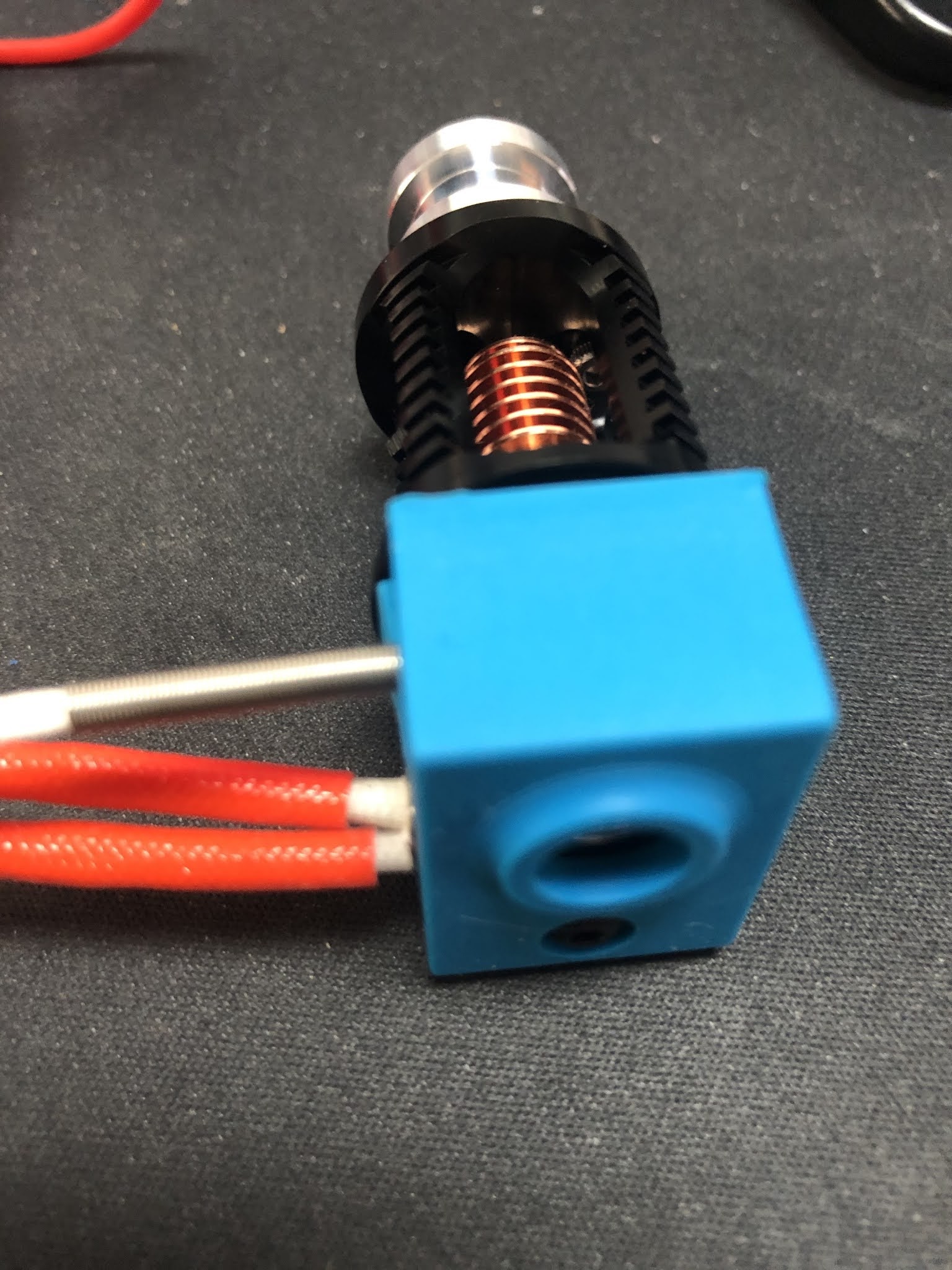
The Dragon hot-end comes in this plastic case with the parts, some spare parts and some hex wrenches. Keep in mind that you only get the hot-end, but no heater cartridge or temperature sensor.

BTW: This is the high flow (vulacno like) version. I have the normal version running in another Prusa MK3S clone for a couple of weeks now.


As I ordered the full kit of the BMG extruder there was a V6 clone included that I used to harvest the missing parts for Dragon hot-end. That included the 40W 24V heater cartridge as well as the right temperature sensor for the Prusa(clone).


I really liked the temperature sensor with the metal spring sleeve. Usually the cables of the temperature sensors are the ones that get damaged when people are careless when working on the hot-end.


Even though there was a silicon sock included with the Dragon hot-end. But I wanted to use the one from the V6 clone as well. There is a little problem with the fit as you can see.


But easy to fix with a sharp knife. Just cut the lip off on both sides for 2mm.


After that we have our Dragon hot-end nearly complete.


For the BMG extruder clone I strongly suggest to study the assembly manual from Bondtech® as a reference. 

So I will focus on the differences here and not spent the effort for a complete guide.

Frist of all download and print this little tool from Bondtech® that helps you to cut the PTFE tube to the exact length of 6.3mm. Don't forget to create a inner chamfer with a drill bit at the end.


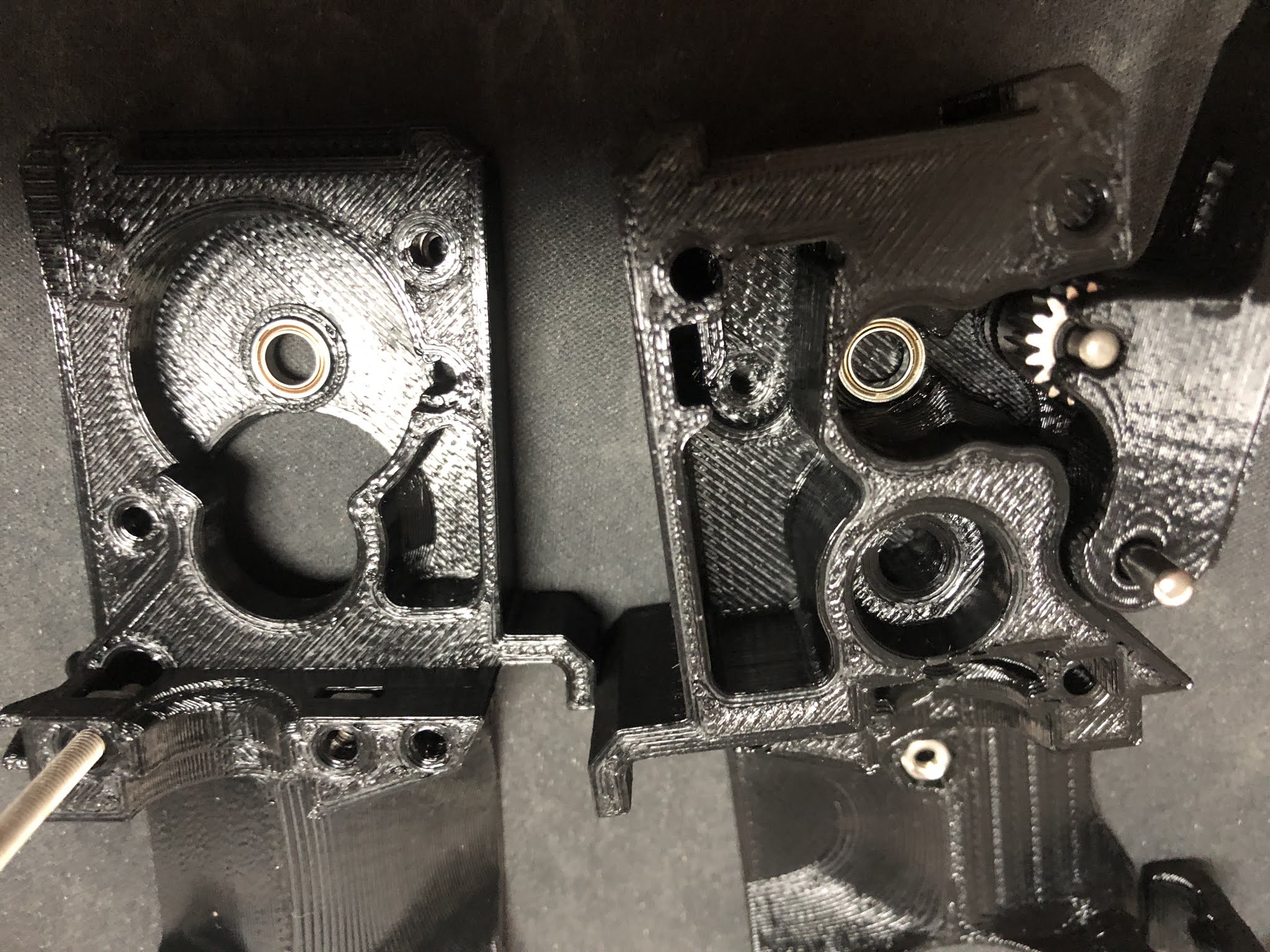
So know it is time to start preparing the 3D printed parts. First of all I check that the filament path is ok, by sticking some filament thru it. It is a tight fit, but that is ok. You cannot have a lot of play if you ever want to print flexible filament with it. Those parts come in their own bag and have a decent quality.

Those printed parts are from the FDM conversion of the BMG extruder by Marco Zambon (Marco Z76) that shared his files on Thingiverse. Big shoutout to Marco for his work!


Then you have to mount the threaded inserts, but be careful. 

1) They are not at the same spots as the original Bondtech® BMG extruder!

2) Make sure you insert them properly with a soldering iron and don't tilt it(not like it did in this photo)!


You have to insert 3 of them, this is the first.


Here goes the 2nd.


And that is the last one.


Again, make sure the are straight in and just a smidge under the printed surface. I have heated my soldering iron up to 220°C. The prints become soft like butter at this temp and you only got one shot to get it right. If you start to wiggle around the printed part is ruined and the insert will not sit tight.

In the next step you need to insert all the square nuts and some "normal" M3 nuts. Especially this one is not reachable anymore once you have insert the hot-end. I use a longer M3 screw to push them in straight. 


Now we need to prepare the plastic gear on the shaft, as we use it as tool to press fit the bearings. Put the extruder gear with the lock screw on the shaft and make sure the lock screw is on the flat side of the shaft. Do not over tighten this screw, you will need to adjust the height in a later step and this is a very small thread that is easily damaged.


Then put one of the small 5 x 8 x 2.5 mm gears on the end of the shaft.


Now use this assembly to press fit the bearing into the 3D printed part. Make sure you don't tilt it as this will ruin the bearing and the seating. Then follow the same procedure for the other 3D printed part.


Next is to prepare the stepper motor. You need to adjust the height of the gear that there is around 1mm space between the gear and the stepper chassis. If that gear is mounted to high, you will grind down the plastic gear that interlocks with it. Make sure you got the orientation right and the little lock screw facing the flat side of the shaft.
 

Then we have to insert a M3x10 screw in this hole. It takes a bit of wiggling, but make sure to down damage anything as there will be a square nut inserted in a later step.


Next step is to mount the motor with 3 screws as shown here. The one on the left down corner is the one we inserted in the previous step. When you tighten the screw the hex wrench goes thru the hole in the 3D printed part. Again, don't mess it up! When you insert the plastic gear you can now check that the gears have proper contact with all the surface of the teeth on the plastic gear. If not, then the gear on the motor is too high.


Now it is time to insert the square nut. In my case it was not a very tight fit, so I decided to secure it with a drop of superglue. As you can see it inserted a long M3 screw to make sure there is not superglue in the threads of the nut. I also kept turning the screw to avoid the screw being glued to the nut.


I did move on to the lever next. When you open the small bag with the gears, this is how it looks like.
They put the needle bearings on the long shaft. THAT IS WRONG!


As you can see here, the long shaft is used to mount the lever in the housing, the short one is used with the needle bearings as axle for the other drive gear.


If you mix the shafts up and press fit the short one into the housing with the lever, you will not get it out anymore.

Next step is to assemble the magnets and parts for the filament sensor. Just follow the instructions from the Bondtech® or Prusa® assembly manual. 

If you habe completed both side of the housing it should look like this. Make sure you have the setscrew on the shaft with the plastic gear facing to the lever(it is on the wrong side in this picture). You cannot turn the gear once the two side of the housing are together.


In my case one screw was no flush with the 3D printed part and causing problems. I ended up cutting away a little piece of plastic on the other side to make it fit.


After that it fitted perfectly and next if to use the x-carriage mount and the long M3 screws to finally hold the 2 parts of the housing together.

Next steps are outlined in details in the Bondtech® assembly manual I linked in the top of this post. Basically mount the Fans, the Pinda probe and take care of the cables. Don't forget to align the drive gear on the shaft with the plastic gear.

Once you got this done you got yourself an extruder/hot-end combo like this.


You may have noticed that there was no nozzle in the hot-end all the time. The reason is simple. I started to use the original E3D Nozzle-X in all my printers in 2019 and never had to replace a nozzle ever since. I did not have any of those nozzle at hand when I built this. But the nice thing about the Dragon design is that there is no risk of loosen up the heartbreak from the heat block when working on the nozzle. You might twist the whole hot-end in the extruder body, but you can easily twist it back in position.

I usually heat up the hot-end to 80°C and then just slightly tighten the nozzle. Especially with the copper heat blocks you can easily mess-up the heat block with too much force. Copper is a soft metal and those are small threads.

I hope that guide helped a bit if you want to build your own clone.

Last tip. If you don't have changed anything else on your clone that would require changes to the firmware, the use the firmware that Bondtech® provides for the MK3(s) and flash on the Einsy Rambo board. Besides the 3:1 ratio for the stepper motor they might have done more changes(I did not check this).
Also important! After flashing the Bondtech® version of the Firmware you have to perform a full factory reset in order to get the settings for the 3:1 ratio of the extruder stepper motor to become active. All this is outlined in their manual.


A new project "automatic cat litter box"

 I did not post any updates for a long time. I spent some time making some money with 3D printing to recover some of the costs from this hob...